Enters active duty as a selective service man. Assigned to Headquarters & Service Company, 136th Medical Regiment, Camp Claiborne, Louisiana. His own officer personnel record lists his principal duty for these eight months in one word: Band. The outfit is photographed four weeks later — see section 03.
201 File · Cline, Alvin G. · 96 documents, Sept 1941 – Nov 1946
Compiled 2026
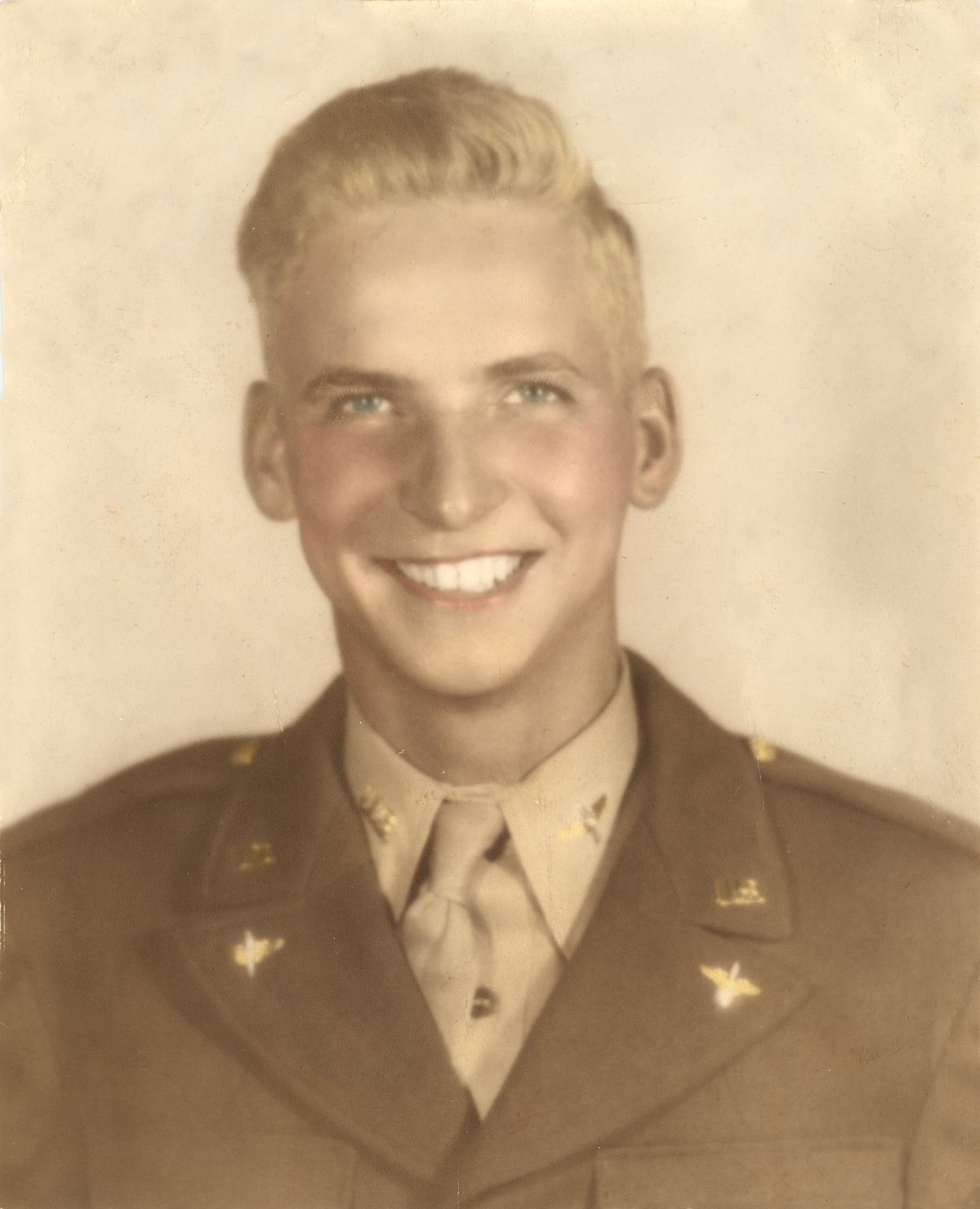
Captain, Air Corps, Army of the United StatesAlvin “Jack” G. Cline
Draftee bandsman to four-engine bomber pilot in eighteen months; fifty-one combat missions with the 352nd Bombardment Squadron over Italy, France, Greece, Austria and Germany; then two more years teaching what he had learned.
Alvin on every order in this file; Jack to everyone who knew him, his wife included. His mother named him for Sgt. Alvin York; her side of the family, who wanted a John after both grandfathers, quietly called him John and then Jack from infancy, and it stuck.
Serial No. — OfficerO-794530
Serial No. — Enlisted37044150
Known AsJack
Date of Birth5 September 1918
Home of Record1804 Davenport Ave.
Davenport, Iowa
Davenport, Iowa
Marital StatusMarried — Mrs. Mavis M. Cline
EducationHigh school, Jan. 1937
RatingPilot, four-engine
13 Dec 1942
13 Dec 1942
Active Duty From20 May 1941
Last Order on File21 Nov 1946
Eglin Field, Fla.
Eglin Field, Fla.
01The Record in Figures
51Combat missions
380:40Combat hours
9Oak leaf clusters
619:40Flying hours at 15 Jul 43
7Months in combat
Note: the squadron's own certificate transposed its two totals — it reads “Total Combat Hours 51 / Total Combat Missions 380:40.” The figures are correct; the labels are reversed.
02Chronology
1941
20 May
19 Nov
Transferred in grade from Headquarters & Service Company to Company H, still a private.
1942
20 Jan
Leaves the medical regiment for aviation cadet training. The file keeps the War Department's instruction sheet for cadets reporting to Maxwell Field: bring one suit, one topcoat, one piece of hand luggage, and a little money for expenses before the first pay day.
13 Dec
Graduates Class 42-K at Turner Field, Albany, Georgia. Commissioned Second Lieutenant, Air Corps Reserve, rated Pilot, and ordered the same day to the Four-Engine Combat Crew School at Smyrna, Tennessee, for heavy bombardment.
1943
20–25 Feb
Qualified four-engine heavy bomb. Routed through the 18th Replacement Wing at Salt Lake City to the 34th Bombardment Group, Blythe, California.
9 Apr
At Rapid City with the 383rd Bombardment Group; flying as co-pilot in Crew 34-3-14 under 2nd Lt. Lloyd A. Christman, attached to the 540th Squadron at Ainsworth, Nebraska.
19 Jun
Now first pilot of his own crew — Crew L-15, later 6-12 — with Italo J. Cruciotti as co-pilot, Edward C. Lingenheld navigating and Donald G. Hendrixson bombardiering. Phase training moves to Smoky Hill Army Air Field, Salina, Kansas.
30 Jun
Overseas movement orders, shipment FG-724-AT, via Presque Isle, Maine. Aircraft assigned: B-17F 42-30443. Families are told to write to APO 12159, c/o Postmaster, New York.
13 Jul
Ferries the aircraft England to North Africa — 9:30 in the air, later counted as mission 36 on his own log.
15 Jul
Joins the 352nd Bombardment Squadron, 301st Bombardment Group (H), APO 520 — Twelfth, later Fifteenth Air Force, flying B-17s out of North Africa and then Italy.
19 Jul
First combat mission: Rome. Seven hours.
28 Aug
Group letter recommends the Air Medal for personnel completing five sorties against the enemy; his crewmates appear by name.
23 Dec
Appointed “D” Flight Commander of the squadron, confirmed by written order on 1 January.
1944
15 Jan
Moves to “C” Flight Commander.
10 Feb
Promoted Captain (AUS) by direction of the President, over the signature of Maj. Gen. Twining at Fifteenth Air Force. “No commissions will be issued during the period of the war” — the letter itself is the proof of rank.
24 Feb
Last mission: Steyr, Germany, counted double. That same day his squadron commander certifies him relieved from combat flying on completion of the theater's fifty-mission tour, recommends he be kept in heavy bombardment as an instructor, and puts him forward for Squadron Operations Officer.
26 Feb
Relieved as flight commander; replaced in “C” Flight by 2nd Lt. Kobokkita.
13 Mar
Travel orders home by military aircraft to a U.S. airport, thence Reception Station, Fort Sheridan, Illinois. Baggage carried by air limited to 55 lbs. Leave address: 1804 Davenport Ave.
21 Mar – 24 Apr
Processed through AAF Redistribution Station No. 2, Miami Beach, and assigned to the AAF Tactical Center, Orlando, Florida.
21 Jun
Passes the instrument flight test at Pinecastle Army Air Field, Florida — AAF Form 8, signed by the check pilot and a board member.
4 Aug – 30 Oct
Serving with the 901st and 903rd AAF Base Units (Bombardment) at Pinecastle; sits on a board of officers examining a flight officer for commission.
30 Oct
The 301st writes after him: he is entitled to wear the Distinguished Unit Badge with cluster for the group's citations, WD General Orders No. 66. The letter chases him through three headquarters before catching up in January.
1945
26 Apr
Relieved from Pinecastle, assigned to headquarters at Orlando as Training Aids Officer, Training Branch, Directorate of Operations and Training.
9 Aug
Temporary duty to the Training Aids Division, New York, three days, to inspect and coordinate training aids for the command.
8 Oct
Announced as Assistant Chief, Training Branch — a step up on the same staff.
13 Dec
The Adjutant General promotes him to First Lieutenant, Air Corps Reserve — his permanent grade catching up beneath the wartime temporary captaincy, which he continues to hold.
1946
Feb – Jun
Orders follow the drawdown from Orlando to Eglin Field, Florida, and the 610th AAF Base Unit.
19 Jul
Duties at Eglin: relieved as Training Aids Officer, appointed Assistant Club Officer — the peacetime air force in one line of orders.
16 Oct
Appointed auditing officer for shipping tickets covering government-furnished meals.
21 Nov
Relieved of the auditing duty in favor of a lieutenant colonel. This is the last document in the file.
03The Band, Camp Claiborne
Before any of the flying, there was a regimental band. Cline entered active duty on 20 May 1941 and spent his first eight months in it — his own officer personnel record gives his principal duty for that period in a single word, Band. Four weeks after he arrived, the whole outfit sat for a panoramic portrait.
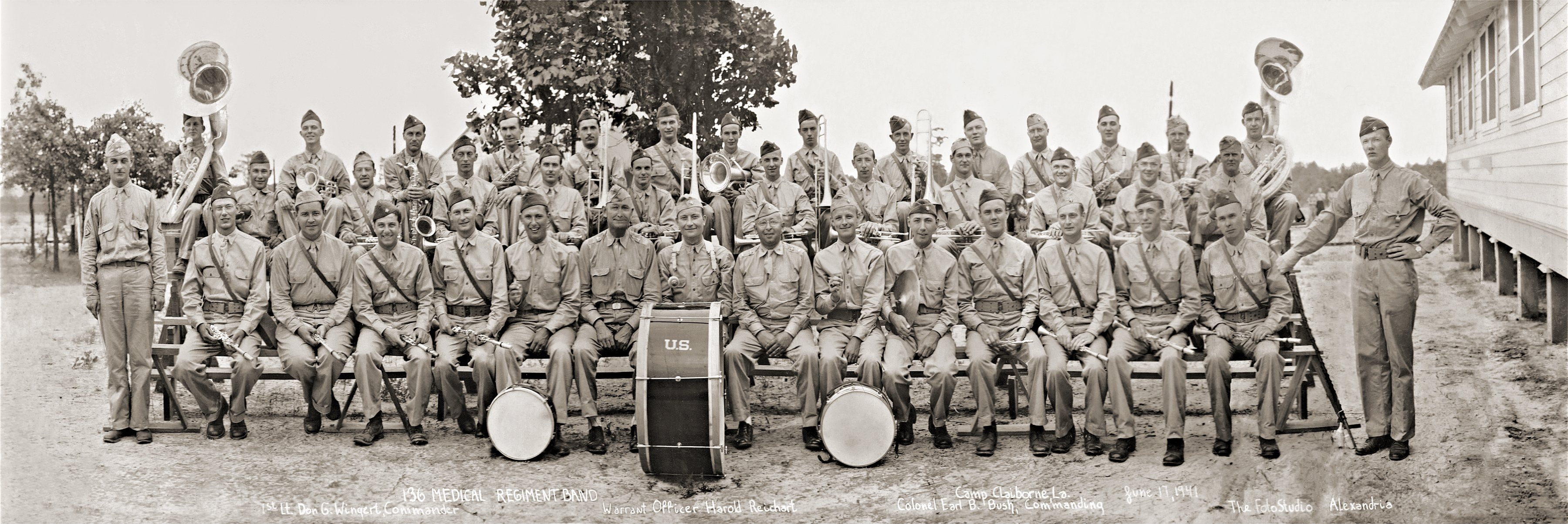
1st Lt. Don G. Wingert
Band commander — and, five months later, the officer who signed Cline's transfer order as regimental adjutant. His signature block appears on the 19 Nov 1941 order in this file.
W.O. Harold Reichart
Warrant officer bandmaster — the man who actually ran the band. He signs the roster sheet too: Harold L. Reichart, Council Bluffs, Iowa.
Col. Earl B. Bush
Commanding the 136th Medical Regiment. The transfer order in this file was issued by order of a Lieutenant Colonel Fourt, his successor or executive.
A worksheet in the same collection places the unit precisely: 34th Division → 68th Infantry Brigade → 136th Medical Regiment → Regimental Band. It also carries the one enlisted serial number recovered for any bandsman — Gilbert Schlappy of Chapman, Kansas, 37006634. Cline's own enlisted serial, 37044150, sits in the same block, which is how National Guard and selective service men from the same region were numbered.
The roster below is transcribed from two sheets of notepaper kept with the photograph, headed 136 Med. Regt Band — names and hometowns written out in pencil and ink. Nearly every man is from Iowa, which fits a 34th Division regiment; the outliers are a few from Kansas, Missouri, Illinois and Minnesota.
Garrett W. BiersbornLincoln, Iowa
Robert H. ChessmoreIndependence, Iowa
Joe Fritchett reading uncertainTribune, Kans.
Budd W. GarrettBurlington, Iowa
Selvin L. GolobLivingston, Ill.
Mads V. GundersenCorrectionville, Iowa
Ralph P. HallDes Moines, Iowa
Morrie HaskellFt. Dodge, Iowa
Frank HathawayHannibal, Mo.
Ray R. HaydenFort Dodge, Iowa
Charles HazeltonCalmar, Iowa
Howard N. InghamSpringfield, Mo.
Clifford A. JohnsonDes Moines, Iowa
Elmer E. JohnsonClinton, Iowa
Billy Jack KingNashville, Ark.
Robert H. LauserWilton Junction, Iowa
William LindsmanLittle Rock, Iowa
Maurice E. McCallEstherville, Iowa
Donald B. McNuttAudubon, Iowa
Leonard MerklinIowa Falls, Iowa
Karl B. NielsenCedar Falls, Iowa
Eddie “Shoes” NortonDavenport & Des Moines
Woodie OslundFargo, N. Dak.
Kenneth B. PorterStafford, Kans.
Harold L. Reichart bandmasterCouncil Bluffs, Iowa
Robert L. ReishusRushford, Minn.
Simon B. RosenbergMuscatine, Iowa
Alfred R. Rossman buglerWestside, Iowa
Grant S. Sanders, Jr.Plover, Iowa
Gilbert SchlappyChapman, Kans.
Richard T. StackChamois, Mo.
Ira B. ThorsenWaukon, Iowa
John VanFossenLisbon, Iowa
Clayton L. WallinNew Windsor, Ill.
Kennie YoungDes Moines, Iowa
Every one of these surnames was searched against all 96 documents in the service file. None of them appears. The only two documents from the 136th Medical Regiment name no enlisted man but Cline himself — the band survives in photographs and a penciled list, not in the orders.
04The Class Photograph
Kept in the family as his graduation as a pilot, with the flight crews. It is the one item in either folder that carries no caption at all — no date, no station, no photographer's imprint, and no names along the margin. What follows is only what the picture itself shows.

Two readings fit the record, and the photograph does not settle between them.
The graduation. Class 42-K at Turner Field, Albany, Georgia, 13 December 1942 — the day he was commissioned and rated. A graduating class would explain the scale and the officers at centre.
The crews. Two hundred men is also exactly what a heavy bombardment training group came to: twenty crews of ten. The June 1943 orders in this file list about that many in the Loney Provisional Group at Rapid City, Cline's Crew L-15 among them, and they moved together to Salina and then overseas. That reading fits “all members of the flight crews” more literally, since a pilot class would be pilots only.
Against the first: the men are in warm-weather khaki, and the pines and sand look Deep South rather than December in Georgia. Against the second: Rapid City and Salina are plains country, not pine woods. Someone who knows where he was standing may settle it in a sentence.
One near-miss worth recording: the front matter of As I Remember It credits its cover to an “air cadet graduation photo, December 13, 1942.” That turns out to be the hand-tinted studio portrait at the top of this page, not this panorama — so the book does not settle the question either.
05The Crew and Mickey Joy
B-17F 42-30443, drawn new at Blythe in March 1943 and named for his wife — Mavis, called Mickey, middle name Joyce. The crew painted the name on themselves. She carried them from Kansas to Maine to Scotland to North Africa, and through the first two-thirds of his tour.
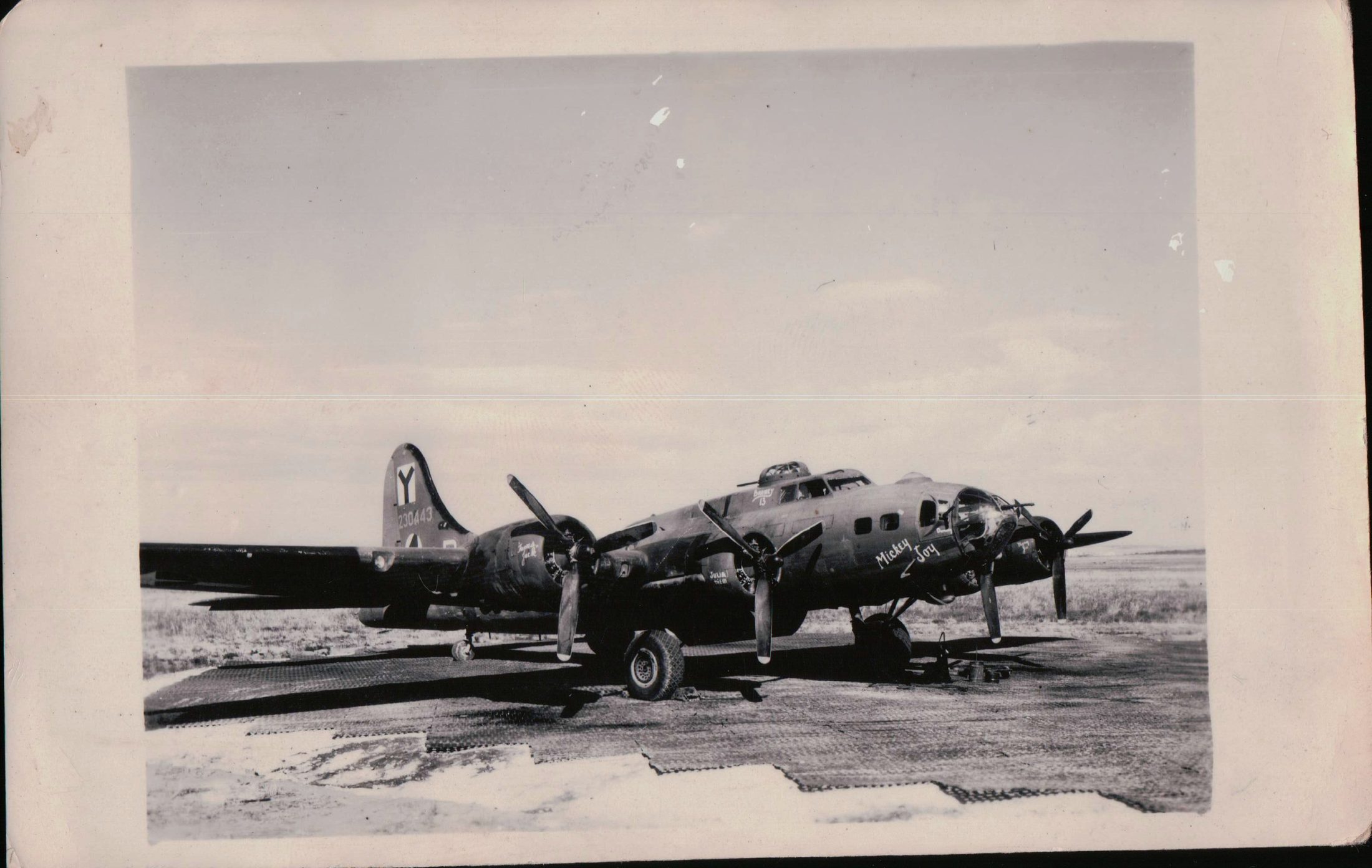
The crew as the family recorded it, with the serial numbers the orders give. Three of the hometowns on that list — Dedicke of Newport, Caylor of Uniontown, Cole of Midland — are confirmed word for word by the group's Air Medal letter of 28 August 1943.
PilotAlvin “Jack” G. Cline
Co-pilotItalo J. Cruciotti
NavigatorEdward C. Lingenheld, Jr.
BombardierDonald G. Hendrixson
Engineer · top turretLawrence J. Reffert
Assistant engineerHarold J. Sbaschnig
Radio operatorRobert E. Hunsberger
Assistant radio · gunnerEdward C. Dedicke
Tail gunnerJames W. Caylor
Waist gunnerCharles O. Cole
Cruciotti — “Johnnie” — transferred to pursuit aircraft in August 1943 and was replaced by 2nd Lt. Peter L. Richards of New York City, who appears in the same Air Medal letter. Caylor took flak through both hands over Bolzano on 25 September and was back on the crew in two weeks. Cole and Sbaschnig were shot down on the Regensburg raid of 25 February 1944, the day after Cline finished his tour, and spent the rest of the war as prisoners. All ten men came home.
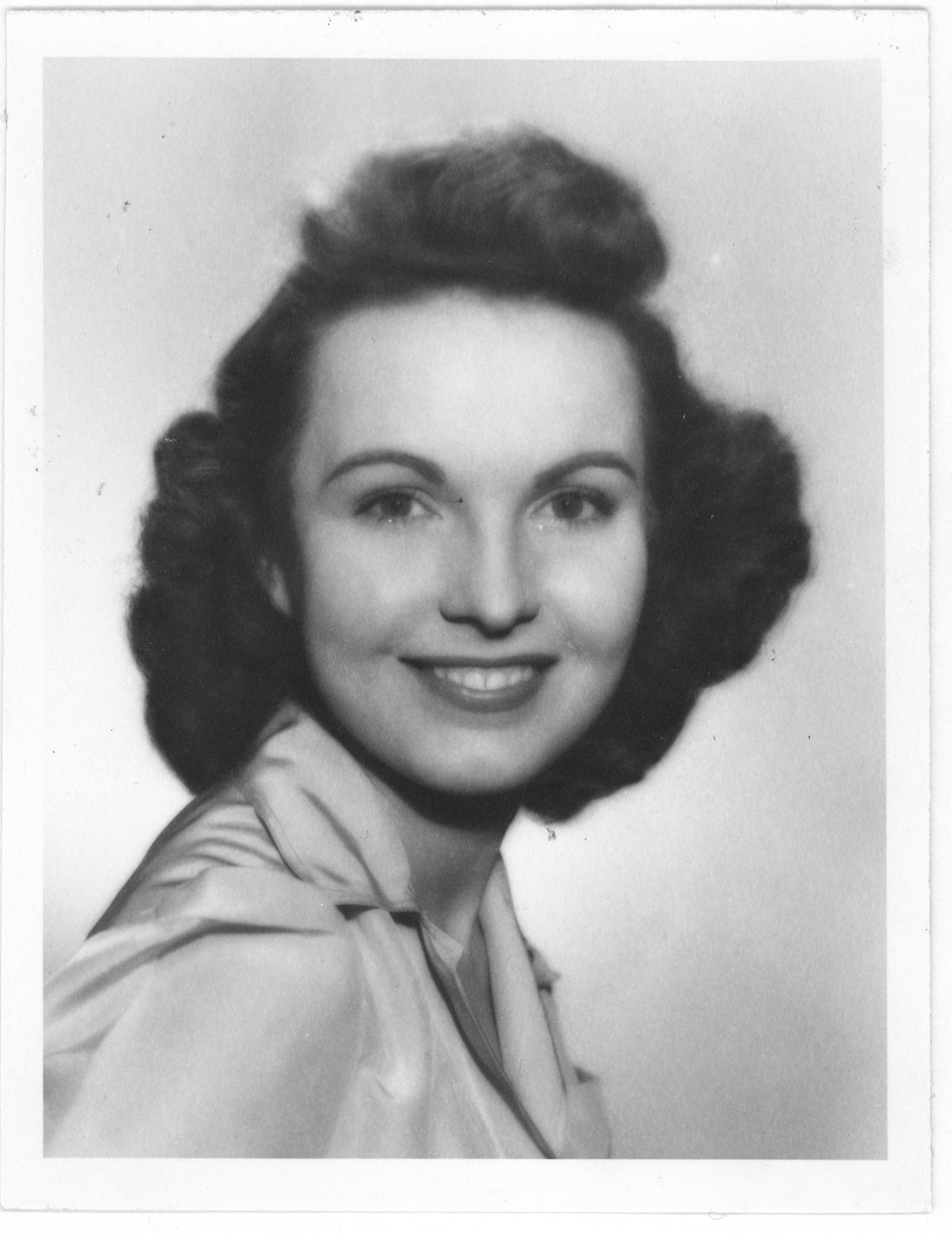
He carried this photograph through fifty-one missions. His caption for it in the memoir, fifty years later, was three sentences long:
“This is a picture of Mickey I had with me on combat duty. My tent mates said, ‘She is prettier than a movie star.’”
Mickey and Jack had married at the Smyrna Army Air Base chapel on 7 February 1943, under a canopy of raised swords borrowed from a Nashville lodge, eighteen days before the orders sent him to Blythe — no dependents. He was overseas by July. His personnel record that summer lists her at 1804 Davenport Avenue, and the dedication of his book, fifty-four years on, reads: “Mickey, my wife of 53 years, who did the research.”
06Combat Log, 352nd Bomb Squadron
Transcribed from the operations officer's certificate of 23 February 1944 — a single typed sheet listing every mission Capt. Cline flew as pilot. Target names are given as typed; obvious misspellings are corrected in the margin. Incomplete missions and aborted sorties are listed in the original and shown here, unnumbered, in their typed positions.
| No. | Date | Target | Hours | Flight time |
|---|
— unnumbered: incomplete mission or aborted sortie
36 ferry flight, counted as a mission
* as typed — hover for the correct reading
07As I Remember It — Addendum
As I Remember It (1997) — bylined Alvin G. “Jack” Cline, Lt. Colonel USAF Retired, and written with his daughter Cynthia S. Partington — covers the same years from the inside. Checked line by line against the orders, it holds up unusually well — and it answers two questions the paperwork leaves open.
Confirmed to the day
“Drafted in May of 1941 … a private in the Iowa National Guard … 34th Division, 136 medical regiment band.”Active duty 20 May 1941; duty listed as Band; the worksheet gives 34th Division → 136th Medical Regiment.
“By Jan 22, 1942, I was on a train headed for Maxwell.”Aviation cadet from 20 Jan 1942.
“I graduated … on December 13, 1942, and received my wings.”Rated pilot effective 13 Dec 1942, Class SE-42-K, Turner Field.
“I would finish on February 20th” at Smyrna.SO 45, Smyrna, dated 20 February 1943, releases him.
“By February 25, 1943 … Headquarters 18th Replacement Wing, Salt Lake City.”SO 56, 18th Replacement Wing, 25 February 1943.
“I was sent to the 34th Bomb Group at Blythe, California, no dependents allowed.”The order reads “(No dependents unless auth by CO new sta)” — his phrase is the paperwork's.
“Our brand new B-17F, serial # 42-30443, which we named Mickey Joy … I was pilot of crew twelve.”Movement order: “CREW No. 6-12 Plane No. 42-30443 — 1st Lt. Alvin G. Cline.”
“My crew flew our newly assigned plane to the 540th Squadron at Ainsworth, Nebraska … on April 2, 1943.”“atchd 540th Sq Ainsworth Nebr AAB, as of April 2/43.”
Major Looney's group staff: Barrowclough, Barneson, Chambers, Greenwood (bombardier), Alois (navigator), Vetter (surgeon).The Loney Provisional Group roster names all six, in those roles. He spells it Looney; the orders spell it Loney.
“In August I flew eight missions.”Eight: 1, 4, 5, 11, 13, 17, 25 and 31 August.
“Between September 4 and 17, in fourteen days, I flew twelve missions.”Twelve, exactly those dates.
“I flew on the 27th, 29th, 30th, and 31st” of January 1944.Montpellier, Bologna, Villaorba, Klagenfurt — all four.
Kalamaki “a nine hour and fifty minute flight”; Klagenfurt “a six hour and fifteen minute mission”; Steyr “7 hours and 15 minutes … credit for two missions.”9:50, 6:15, 7:15, and Steyr numbered “50–51.” Fifty years on, to the minute.
“From second lieutenant to captain in one year and two months.”13 Dec 1942 to 10 Feb 1944.
Groomsmen Seay of Elk Hill VA, Love of Danville VA, Williams of Perrysburg OH, Smith of Winter Park FL.The Turner Field graduation order lists those four men at those four addresses.
Billeted at “the Good Hotel” in Miami Beach.A April 1944 letter is addressed to him at “Sqdn. 2, Good Hotel, Miami Beach, Florida.”
Where the memoir fills the file's gaps
The seven-week hole in the combat log, 5 October to 22 November 1943.Yellow jaundice. He was hospitalized from about 12 October, along with his radio operator and his co-pilot. The orders never mention it.
The three-week hole, 3 to 27 January 1944.The bends. A rough eight-hour mission to Turin left his left arm nearly paralyzed; grounded from combat, he flew courier runs instead — “Listed as ‘bends’ in my 301 file.”
What became of Mickey Joy.While he was in hospital another crew put 42-30443 down on Corsica with two engines afire; the Germans strafed the field that night and burned her beyond repair.
What happened after the file stops in November 1946.Told in January 1947 he was no longer needed as the Army cut personnel by half; Col. Randolph — the same Randolph who signs the last order on file — promoted him to major on the way out. He stayed in the reserve and retired a lieutenant colonel.
Where they diverge
“Sofia, February 17, 1944” — bombing the German commands in the city after a smokescreen at Toulon.The certificate has no Sofia at all. For 17 February it has Campoleone — on the Anzio beachhead.
“Anzio Beach, February 12, 1944 … of the twenty one planes I started to lead, only six arrived.”12 February is logged as an incomplete mission of 2:00. The two recollections look transposed.
“I didn't go on the Regensburg raids myself,” dated 23 and 25 February.Incomplete sorties are logged on 20 and 22 February, and the Fifteenth's Regensburg raids were the 22nd and the 25th — so he may have started one of them.
“391 combat hours as a command pilot-flight leader.”380:40 on the squadron's certificate, which the memoir also quotes correctly elsewhere.
“On December 25, I was G Flight Leader of the 352 Squadron.”He commanded “D” Flight from 23 December, moving to “C” Flight on 15 January. There was no G Flight in the orders.
Kalamaki, 6 December, “our last mission flown from Africa.”Eleusis followed on 8 December, a day before the group moved to Italy — and the memoir itself mentions that mission later.
Mission tallies in the wartime letters — “twenty seven missions completed” on 21 September, “thirty” on 22 October.Each runs one ahead of the certificate, because he counted the 13 July ferry flight from England that the squadron numbered 36th.
Flown from Salina “to Bangor, Maine”; groomsman Wade Sneed “from Atlanta.”The movement order routes the shipment through Presque Isle; the graduation order gives Sneed's address as Augusta.
08Awards
Air Medal
Awarded under AR 600-45 for meritorious achievement in five sorties against the enemy, Mediterranean theater.
301st BG ltr, 28 Aug 1943
Air Medal — 1st through 9th Oak Leaf Clusters
Nine further awards, one for each subsequent group of sorties across the fifty-one-mission tour.
352nd BS certificate, 23 Feb 1944
Distinguished Unit Badge, with cluster
For the two Presidential Unit Citations awarded the 301st Bombardment Group (H); worn as a unit award by everyone who served in the cited actions.
WD GO 66, 15 Aug 1944
Instrument pilot certification
Not a decoration, but the qualification the post-combat years were built on: AAF Form 8, Pinecastle Army Air Field.
21 Jun 1944
09What the File Does Not Say
- Nothing after 21 November 1946: no separation orders, no terminal leave, no reserve status. The record simply stops at Eglin.
- No aircraft nicknames, no crew photographs, no mission narratives — these are personnel and operations orders, not a diary.
- Nothing about the two long gaps in the combat log — the jaundice that took him off flying in October 1943, and the bends in January 1944. Both are absent from the orders; only the memoir accounts for them.
- His officer personnel record types his serial as 0-794536; every other document in the file reads 0794530. The latter is correct.
- No caption on the class panorama — the only wholly unlabeled item in either folder, and the reason section 04 has to argue with itself.
- No key to the band photograph. Thirty-five men are named on the roster sheets and some four dozen sit for the camera, but nothing says which face belongs to which name — including Cline's own.
10Sources
136 Med. Regt BandPanoramic photograph, Camp Claiborne, 17 June 1941 — The FotoStudio, Alexandria
Names-pt1 · Names-pt2Two handwritten roster sheets kept with the photograph — names and hometowns
Medical Regiment BandWorksheet — unit hierarchy from 34th Division down to the band, and Schlappy's serial number
Alvin_G_Cline-Military_UnitUncaptioned panorama of roughly two hundred airmen, undated — “Photos First Edits”
As I Remember ItAlvin G. Cline & Cynthia S. Partington, Cline Publishing 1997 — memoir, wartime letters to Mickey, his 1944 briefing to the AFTAC board, and the crew list
Cover portraitHand-tinted studio photograph, credited by the book to 13 December 1942
Mickey JoyFamily photograph of B-17F 42-30443 on steel matting, undated
Mavis ClineStudio portrait — the photograph he carried on combat duty
0910-19NOV1941SO 165, 136th Medical Regiment, Camp Claiborne — Pvt. Alvin G. Cline, 37044150; signed by Lt. Wingert
0911-07DEC1942Personnel Orders 10, AAF Southeast Training Center — rated Pilot eff. 13 Dec 1942
0912-13DEC1942SO 330, Turner Field — commission and assignment to four-engine school, Smyrna
0914-25FEB1943SO 56, 18th Replacement Wing — to the 34th Bomb Group, Blythe, California
0915-09APR1943SO 120, 383rd Bomb Group — Crew 34-3-14, co-pilot
0916-19JUN1943SO 167, Rapid City AAB — Crew L-15, first pilot
0918-30JUN1943SO 181, Smoky Hill AAF — overseas movement, shipment FG-724-AT, B-17F 42-30443
0920-15JUL1943Officer Personnel Record — birth date, family, education, service history, 619:40 hours
0921-29JUL1943SO 157, NW African Air Forces — assignment to the 301st Bomb Group
0922-01AUG1943SO 92, 301st Bomb Group — assignment to the 352nd Bomb Squadron
0924-28AUG1943Awards and Decorations — Air Medal, five sorties
0928-01JAN1944Squadron Order 1 — appointed “D” Flight Commander
0929-15JAN1944Squadron Order 3 — appointed “C” Flight Commander
0931-PRO-10FEB1944Fifteenth Air Force — temporary promotion to Captain
0933-TCHM-23FEB1944Total Combat Hours & Missions — the mission log transcribed above
0934-PECF-24FEB1944Placement of Experienced Combat Flying Personnel — relief from combat, recommendations
0935-SO7-28FEB1944Squadron Order 7 — relieved as flight commander
0943-TravelOrders-13MAR1944Travel orders, Personnel Center No. 1 — return to the United States
0948-SO114-24APR1944SO 114, Redistribution Station No. 2 — assigned to AAF Tactical Center, Orlando
Flight Cert 21JUN1944AAF Form 8 — instrument flight test, Pinecastle
0953-ON11-30OCT1944Squadron Orders 11, 903rd AAF Base Unit — board of officers
0957-Awards-30OCT1944301st Bomb Group — Distinguished Unit Badge with cluster, WD GO 66
0962-SO116-26APR1945SO 116, AAF Tactical Center — announced as Training Aids Officer
0973-SO63-9AUG1945SO 63, AAF Center — temporary duty, Training Aids Division, New York
0974-SO110-8OCT1945SO 110, AAF Center — Assistant Chief, Training Branch
0978-AESjws4415-13DEC1945The Adjutant General — promotion to First Lieutenant, Air Corps Reserve
0992-SO24-19JUL1946SO 24, Eglin Field — training aids officer to assistant club officer
0999-SO113-21NOV1946SO 113, Eglin Field — relieved as auditing officer; last document on file